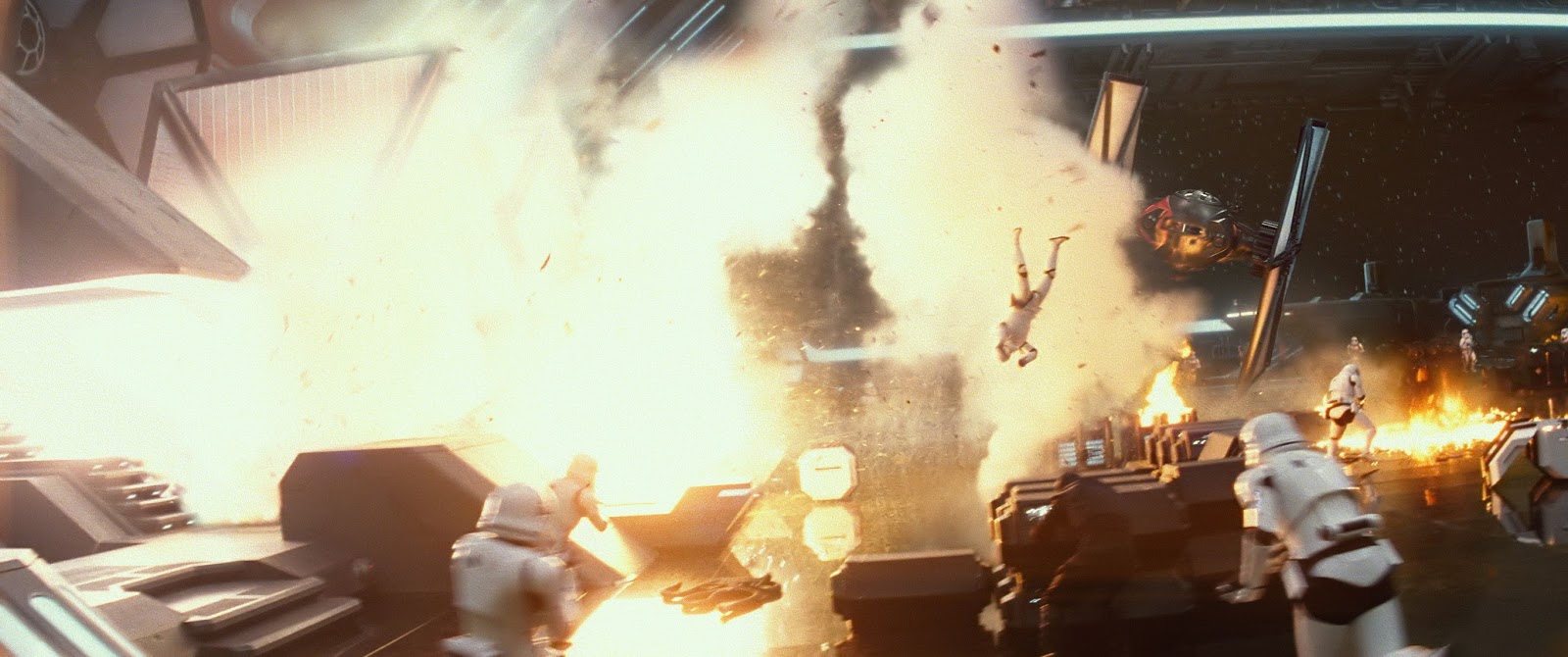
In April, Star Wars Celebration Anaheim took place. There we got our first real look at Episode VII, starting with the second teaser trailer.
WOW.
It's funny. Much like the last teaser, this one doesn't really tell us all that much about what's happening. We just get little glimpses. It is a teaser after all, not a trailer. But those glimpses are so much more powerful and rich with detail than they were in that first teaser. But the biggest thing about the teaser isn't so much any specific detail, but the way that all the aspects of it build into one idea. I'll explain in a bit.
That voiceover. Hearing Luke's lines from Return of the Jedi again gave me all kinds of chills. Normally reused lines aren't my favorite thing in trailers, but this made it really work. Part of it has to do with the fact that it ties The Force Awakens back to the Original Trilogy in a way nothing else has yet, but there's also the fact that it seems to imply a lot about the movie's story. Luke is talking primarily about three things: the Force, family, and the idea of passing on that power to someone new. The lines sync up with the footage and highlight specific ideas: "My father has it" - We see Vader's burnt helmet, probably taken from the Endor funeral pyre. Who took it, and what significance does it have? "I have it" - A cloaked figure with a robotic hand reaches out for R2-D2; almost certainly Luke. "My sister has it" - A short alien figure passes the famous saber of Anakin Skywalker to a woman who we assume is Leia. "You have that power, too" - This is the big one. In ROTJ he was, of course, talking to Leia, but the way the line is removed from the rest of the exchange, it's different. The screen is black, as if Luke isn't speaking in regard to anyone specific. It feels like he's speaking to us. That whole idea—"you have that power, too"—is something that was hugely important to the Original Trilogy, with Luke essentially standing in for us, the audience. We were Luke in the OT; Ben Kenobi and Yoda weren't training Luke; they were training all of us. Symbolically, the trailer seems to hand over the reins of Star Wars to the people again. It's no longer going to be us staring into windows watching monks and politicians go about their idiotic business as in the prequels; this is a story made for us, here and now. I may be reading too deep into that, but it feels right.
There's a big theme in the teaser: relationships. Not only is Luke talking about his family, but all through the trailer we see people reaching out to one another in various ways:
And, of course, it ends with the epic nostalgia moment that is seeing Han Solo and Chewbacca reunited on the Millennium Falcon.
"We're home" is that last beat that sent us all into tears of joy. And it's not just a nostalgia trip, either. Han and Chewie's friendship was never the deepest, exactly, but it always felt real. Maybe like two best friends, maybe like a boy and his dog, but it was always one of the more authentic-feeling things in Star Wars. I've written on this blog before about how Star Wars needs to be a personal story in order for it to be great, and this feels like it's going to do that exactly.
Also there's a bunch of rad stormtroopers and spaceships.
One of them is chrome and has a cape. A CAPE. And her name is Captain Phasma. It's like photon mixed with plasma. It's a cool name.
A quick, light highlight reel from the opening panel where the teaser was first shown:
Shortly after Celebration Anaheim, Vanity Fair revealed their epic photos taken on the sets of The Force Awakens.
One aspect of the Episode VII production that I did comment on in a timely manner was the casting announcement—which you can read here—hence why I'm now skipping it and going straight to the title and teaser announcements.
Before we talk about The Force Awakens' title, let's quickly look back at all the previous movie titles. There are two things that I think are most important in a Star Wars title:
1. It must be accurate to the movie - This should go without saying, really.
2. It needs to be catchy and/or ear-pleasing. Something that feels nice to read and hear.
3. It needs to be exciting. "Active" titles that use verbs or other words that imply action are good.
1977: Star Wars - A lot of people forget that Episode IV: A New Hope wasn't originally called that. It was Star Wars, plain and simple. Short, catchy, epic, and exciting.
1980: The Empire Strikes Back is epic. Arguably the best Star Wars movie title. It's exciting, active, and perfectly accurate to both the events and tone of the movie.
1981: When Star Wars was re-released in 81, it was subtitled Episode IV: A New Hope.A New Hope makes sense given the movie's story, but it's rather flat and boring. However, since it's only a subtitle and wasn't even used at the film's release, it kind of doesn't matter.
1983: Return of the Jedi isn't as powerful of a title as the originally-proposed Revenge of the Jedi, but it makes more sense. After all, it's not as though Luke or any other Jedi actually takes revenge at any point—unless we're counting Vader offing Palpatine at the end? In any case, Return of the Jedi sounds a little too close to the title of The Lord of the Rings' 3rd-and-final book, The Return of the King, but it's still a pretty good title overall.
1999: The Phantom Menace. Honestly, it took me a long while to figure out just what the "phantom menace" was referring to. I suppose Darth Sidious's hologram does kind of look like a ghost, but only kinda. It's also not an active title. Rather than the "phantom" attacking or revenging or actually doing anything, he's... menacing? To be fair, that's a pretty accurate picture of what goes on in the movie, but in that case I think I'd rather have a title like "Attack of the Droid Army" or something that actually describes what action there actually is in the movie.
2002: Attack of the Clones is probably the silliest title, but it's definitely active. It was said by many that the single best part of the entire film was the Battle of Geonosis at the end, so maybe it's fitting that the movie takes its title from that.
2005: Revenge of the Sith is easily the best-fitting title. Not only does it perfectly describe what happens, but it also parallels Return of the Jedi and its original Revenge title. Any Star Wars fan worth their spice knew about the Return/Revenge dichotomy, and the Revenge of the Sith title was instantly embraced.
2015: The Force Awakens.
It feels like it's halfway there. On one hand, it does have a verb—"awakens"—but as verbs go, "awakens" is about as soft as you can get. It's a bit gentle for what is supposed to be an epic action movie. TFA also uses "the Force," which is something that, oddly, no previous Star Wars film has done. It makes sense to reference the Force, so it's nice to have that in a title. On the other hand, we have zero point of reference at this point for what "the Force awakens" actually means. Was the Force asleep? Is it getting more powerful? Is it actually the Force that's waking, or are people in the Galaxy waking up to the Force? I'm left here with questions, but not in a good way. "Awakens" is just too soft a word to denote the primary action or arc of the story. Now, perhaps when the movie is out it'll all make sense. But for now, The Force Awakens is, for me, a title that works just fine, but doesn't exactly soar.
Now then, onto the first teaser trailer:
Well, "teaser" is certainly accurate. We barely see more than glimpses of anything. And here's the worst part: they're teases of things we've already seen, either through official press photos, video messages from JJ on the set, or leaks. Seriously, just about everything in the trailer short of the little ball droid and the crossguard saber were things we'd seen before. In fact, a lot of the teaser felt like a summary of the leaks so far: the stormtrooper helmets, the new X-Wing, the Millennium Falcon, the concept art of Daisy Ridley's character on her speeder, etc. However, since I haven't actually covered any of those leaks, I suppose I'll actually go ahead and give my thoughts on everything in the teaser.
John Boyega in a desert! And that's all we see. He's clearly in distress, but why? No idea.
A ball droid! Also in a desert! Also with no context. He looks good, at least.
Daisy Ridley riding a fudgesicle! I have no thoughts, really.
These new stormtrooper helmets are RAD. Seriously, they might be my favorite trooper helmets ever. Not even joking. The two shots of the troopers we see implies a heavy assault situation of some kind. I liked the intensity of it.
Oh yes. Here we go. X-Wings in flight. We have never seen X-Wings look this good before. It's a new design, but it's actually very close to the old Ralph McQuarrie concept art for the original X-Wing. And having them against the water like that shows just how fast they're going. It's really intense.
And here's a pilot guy. The Rebel pilots were my favorite part of the OT, so this makes me happy for no good reason.
And here we have the thing everybody was talking about: the crossguard/broadsword lightsaber. I like the crossguard. Star Wars has always been more fantasy than science fiction, so a medieval-style laser sword makes sense. Also, the blade looks "rough," almost like it's either a very old saber or one cobbled together without the usual expertise of a Jedi, which implies some interesting things about its origins and its wielder.
And here we have the Falcon. I'd say it's nice to see her, but for some reason this shot doesn't do a thing for me.
Last thing to mention: the voiceover. It's a dark, possibly non-human voice, referring to "an awakening," both of "the dark side and the light." So at least we know now that "The Force Awakens" is an appropriate title, probably. But we still don't know what the awakening means. Are there new Force-users popping up in the galaxy? What exactly is happening with the Force?
So, overall, what did I think of the teaser? Meh. Saber aside, it didn't reveal anything new to the hardcore fans who'd been following Episode VII news, and it "teased" mostly in ways that didn't create interest. The shots were so short and out of context that it really didn't do anything other than say "this is a movie that exists." Which we already knew. After watching the teaser, I think my interest for the movie actually went down, not up.
Bonus Round: Trading Cards!
After the reveal of the teaser, Lucasfilm released photos of fictional trading cards for The Force Awakens meant to mimic the old trading cards for the OT films. This is where most of the new characters' names were revealed.
There's not really much to say about the names, other than the fact that BB-8 is about as perfect a name as anyone could have for that little guy.
So it occurs to me that I haven't really been writing much at all about Episode VII, despite it coming out last this year. So, starting now, I'm going to hyperspace backward in time and cover all of the big moments in Episode VII news.
I already wrote about the Disney purchase and the announcement of the sequel films themselves, so you can read that here.
JJ is an interesting filmmaker. On one hand, he's a genius that makes great stories. He's had a hand in creating lots of TV shows—Lost, Alias, Fringe, etc: fantastic stuff. He's also made some great movies: Mission Impossible III, Star Trek, Super 8, etc. On the flipside, he's got a bad reputation among some fans for essentially turning Star Trek, a highly cerebral science fiction franchise, into a dumb roller coaster ride. While I do definitely agree that the two Abrams Trek films are disappointments and only hurt Star Trek (particularly the second one, I don't particularly share the concerns about his involvement with Star Wars. Here's why:
It's been said more than once that Abrams only made Star Trek in order to help his friends, writers Roberto Orci and Alex Kurtzman, get their Star Trek movie made. He lent his storytelling ability to the project, yes, but he was largely there to pass forward Orci and Kurtzman's vision for Star Trek. Almost every single major fan complaint about the new Trek films is due to decisions made by Orci and Kurtzman, not Abrams. While Abrams is to blame for the "style" of the new Trek films, the real problems with those films were on a script level.
Also, JJ has said repeatedly that he didn't really understand Star Trek, and did the best with what he could. And that's not a crime; countless Trek directors didn't know what they were doing when they stepped into the captain's chair. If one thing is largely true about the Abrams Trek films, it's that they're never lazy. There are countless bad story decisions for sure, but the guiding hand behind the camera is never not trying. In any case, while JJ apparently didn't "get" Trek, he certainly seems to get Star Wars.
With Super 8, JJ showed that while he may not understand Star Trek's cerebral nature, he absolutely understands the Lucas/Spielberg filmmaking style of the 80s—which, of course, includes Star Wars. There's a throughline in all of Abrams' films: feeling. In Abrams films, what's happening in the story, no matter how trivial or how epic, always matters to the characters. Mission Impossible III was the first time in the M:I series that the characters actually cared about anything or were ever in emotional jeopardy rather than only physical. More than that, the cast actually had chemistry. They weren't just Hollywood characters running around in a generic spy plot; they were people that the audience cared about. Star Trek, for all its faults, carries that torch. Kirk and Spock have personal stakes in what happens. Perhaps that's part of the problem: Trek can't be objective and cerebral when its characters are dealing too much with emotion. But just because that style is a bad fit for Trek doesn't mean it's a bad fit for Wars. Quite the opposite, honestly.
George Lucas has said many, many things about Star Wars, but one thing seems relevant here: Star Wars is an emotional story, not a cerebral one. That isn't to say, of course, that Star Wars can't be intelligent or stimulate the audience on an intellectual level, merely that Star Wars is primarily meant to pull at the audience's heart and soul. It's the relationships between people that make the Star Wars original trilogy work so perfectly, and why the prequels often fell flat. Everything that matters in Star Wars matters because it matters to the characters. Luke joins the Rebellion not out of blind principle, but because the Empire made it personal by slaughtering his family. Han saves Luke in the Battle of Yavin because he's come to care for Luke as a friend. Luke throws aside his anger towards Vader out of unconditional love for his father. It's those personal connections that made Star Wars great, and what can make it great again.
Now, of course, you may be wondering: if JJ Abrams wasn't able to make Star Trek great despite making the story personal and emotional, how is Star Wars going to be any different?
"It's not what you say, it's how you say it."
A writer tells a story; a director determines how that story is delivered. A script sets up the drama; a director makes you feel that story. If Episode VII's story is solid, JJ can knock it out of the park. Which leads me to my next point...
JJ is not the only one making the movie. Kathleen Kennedy, a producer who's worked with Lucas and Spielberg for decades, is the current president of Lucasfilm. From a creative standpoint, she effectively has George Lucas's old job: to oversee the story and guide it, even if not directly hands-on. Furthermore, Episode VII's script is largely written by Lawrence Kasdan, who co-wrote The Empire Strikes Back and Return of the Jedi. It's not JJ Abrams alone making Episode VII: it's a dream team of incredibly talented people who are in the perfect position to make a great Star Wars movie.
So, yes, given everything I've seen of Abrams' work (all his movies and a good chunk of his TV career), I think he's a great choice to direct the next Star Wars movie. Last thought: in Super 8, we met a cast of children who were completely unimportant, aside from the fact that they were people, and at the end of the day, that's good enough. For all the talk about destiny and the Force, if there's one thing that made Luke Skywalker a great character, it was that he was essentially just a person. If Abrams can make us care about a group of annoying kids in the 80s, I can't wait to see what he does with the Skywalker legacy.
Next up: the movie's title and the first teaser trailer.
The first draft of the Star Wars screenplay was famously different from the final film. J.W. Rinzler and Dark Horse Comics recently adapted that original screenplay as an eight-issue comic miniseries, The Star Wars. I read it yesterday; here are my thoughts.
First of all, it cannot be overstated just how different The Star Wars is from Star Wars. The plot barely even resembles the movie, and while many characters' names are similar, the actual characters themselves are completely different. Here's a quick list of some of the major differences:
-Versions of Luke, Anakin, and Leia are in the story, but they are all completely unrelated to one another.
-Luke Skywalker is an older, gray-haired, battle-hardened war general.
-Anakin Skywalker is Annikin Starkiller, a young hotheaded Jedi.
-Leia is more spoiled and stuck-up than in the film, and she is princess of the planet Aquilae rather than Alderaan.
-The film character of Anakin/Darth Vader is actually four separate characters in The Star Wars:
-Annikin Starkiller, the young Jedi
-Darth Vader, the non-Jedi brutal war general
-Prince Valorum, a Sith Lord
-Kane Starkiller, Annikin's father, who is revealed to be more machine than man
-The Jedi and the Force are all very different
-The Jedi-Bendu are actual knights, not spiritual monks. No philosophies of non-violence are ever mentioned.
-The Knights of Sith, a rival sect of Jedi, are villains, but not pure evil as in the films.
-The Force is always referred to as "the Force of others," and is never explained.
-The Force is never said to have a light or dark side, and no morality is ever applied to it.
-Jedi don't display any supernatural abilities other than being unusually good with swords.
-Planets
-Coruscant is named Alderaan
-The film versions of Alderaan and Tatooine seem to be combined into the desert planet Aquilae, which somewhat resembles Arrakis from Dune.
-Yavin is the homeworld of the wookiees, and their story is near-exactly the same as the Ewoks' story in Return of the Jedi.
-The Death Star is merely named the Space Fortress.
-Relationships
-There are echoes of the Skywalker family relationships from the films. Kane Starkiller, whose more-machine-than-man body echoes Darth Vader's, has two children, his oldest son Annikin and his younger son, Deak. Leia has two younger siblings, a boy and a girl, who are twins.
-Leia and Annikin have a relationship very similar to the Han/Leia romance from the films, but with the added bonus of the romantic scenes from Luke's rescue of Leia in the Death Star.
-Han and Chewbacca don't meet each other until late in the story. Also, Han is a green alien.
I could list more and more differences, but it would take entirely too long. Suffice it to say that while plenty of names are the same between versions, virtually nothing about the story or who the characters actually are is the same.
When I first began reading the story, I was completely engaged in it. It felt familiar, but a lot closer to Flash Gordon or John Carter of Mars than Star Wars ever was. It was... older; a bit more gritty. Less concerned with moral platitudes and more concerned with epic science fantasy war storytelling. As I read along, a thought crept into my head: could this story actually end up being better than Star Wars? After I finished the book, I mentally responded: Pfff, no.
The Star Wars is fascinating reading, but it has no actual story, at least not one worth telling. Two movies' worth of plot is crammed into a single story, with endless amounts of action and adventure, but absolutely none of it means a blasted thing.
Star Wars is the story of Luke Skywalker: it means something because he means something to us. Watching him grow up over the course of three movies is powerful and relatable; it gives the entire saga meaning where it would otherwise be the tale of a bunch of random people no one cares about running around and blasting each other. And that's what The Star Wars is.
There are entirely too many important characters in The Star Wars (at least 21 by my count, over Star Wars' ten) and none of them grow or change in any way whatsoever. The only development of any kind is the fact that Annikin and Leia suddenly decide they're in love with one another—not too long after he punches her in the face. It's a whole thing. Additionally, the fact that the Force almost doesn't exist is a problem. Without the Force and its literalization of good and evil, the story loses a profound amount of meaning.
So yes, I'm very glad that The Star Wars was never made in its first draft form. Epic battles and a vast universe paint a wonderful canvas, but without the character and meaning to fill it out, it's an empty canvas.
I've spent a long, long time compiling knowledge about lightsabers—both in-universe lore and behind-the-scenes information about the lightsaber props themselves. I figured I'd share.
Behind the Scenes
1. Lightsaber props were made from random junk.
The original lightsaber (Luke/Anakin's in Star Wars) was an old press camera flash handle (a Graflex 3-Cell) with strips of black rubber T-track glued onto its sides to make "grips." Darth Vader's saber was made from a different flash handle (a Heiland MPP), but otherwise followed the same process. Ben Kenobi's saber was made from a shower faucet, a gear, a sink knob, a clamp from a flash handle, and the shell of a World War II British grenade. It wasn't until Luke's second lightsaber showed up in Return of the Jedi that a handcrafted, custom-machined lightsaber prop was first used.
2. Saber props used to actually "glow."
The original "lit" lightsaber props actually had a rotating pole with reflective tape on the blade, so that when a light was shone through the camera lens, the light would bounce back, thus creating a shimmering effect. VFX technology had advanced by the time of The Empire Strikes Back, so this idea was completely thrown out in favor of simply painting over the film footage in post-production.
In-Universe
1. Lightsabers aren't actually made of light
This "fact" is possibly not canon any longer due to the recent continuity changes, but it's been pretty well-established in the Expanded Universe thus far that lightsaber blades aren't "lasers;" they're tightly-wound loops of coiled plasma (the stuff stars are made out of) held in place by a magnetic field. So really, they're plasma chainsaws.
2. Lightsaber blades are opaque
Saber blades apparently block energy, like force fields and blaster bolts. So it makes sense that they'd also block light. This is a screencap from The Clone Wars season 1, "Defenders of Peace:"
Apparently whatever light is shining on Ahsoka is actually brighter than her lightsaber. As someone once put it, "it's like shining a flashlight on a glow stick." It'll still cast a shadow.
3. Lightsabers aren't that bright
For some bizarre reason, lightsabers rarely cast light on other objects near them. Now, in the OT era, this makes sense, as special effects technology wouldn't necessarily allow for that. Or perhaps the science of saber blades is, in fact, much more complicated than we might think, and they really don't cast light on other objects somehow. But then we have scenes like this one from Attack of the Clones:
Clearly, lightsabers actually do illuminate their environment, just to a minor degree. So perhaps they're just not very bright? Maybe the white core of a saber is just an optical illusion of sorts, not actually something bright enough to be white. But The Phantom Menace seems to contradict that.
Here we can see a close-up of Obi-Wan's blade, and (in a brilliant VFX move) it seems that the saber blade is behaving exactly as a white-bright light source does when a camera focuses close to it. In order to counteract the brightness of the blade, the overall exposure is turned down, causing the normally-white blade to appear solid blue. This is proof, of sorts, that lightsaber blades are, in fact, colored blades so bright that they appear white at the center. And they are REALLY bright...
Luke holds his saber up against the sky on Tatooine and it still appears white at the core. So if that's a real representation of the light level of a blade, that means it's brighter than the sky itself, possibly as bright as the sun. And yet it still doesn't actually cast light on other objects.
So yeah. The light levels of a saber blade don't make any sense. The only potential way to justify it is to say that the "camera" is picking up the lightsaber blade the same way cameras often pick up real-world replica lightsabers. Here's an old picture of me holding my Master Replicas Luke FX saber:
Spoilers: it's not actually that bright. At best, it's a solid light blue, but never white like that. The camera overadjusts for the low light and makes it look brighter. Of course, that wouldn't explain why lightsabers in the blinding twin-sun light of Tatooine look white, but oh well.
It seems like for the time being, this is one in-universe mystery that will go unsolved.
4. Sabers move funny
It's a common misconception among geeks that since lightsaber blades are "made of energy," they're weightless, thus when you swing a lightsaber, you're essentially only swinging the handle. That's only partially true, and a lot more complicated.
While plasma is essentially weightless, this doesn't mean that wielding a lightsaber is the same as holding the hilt. George Lucas himself was insistent during the filming of the original Star Wars that lightsabers were supposed to be incredibly heavy due to the incredible amount of energy coursing through them. However, as the OT films progressed and fights became faster, this idea was somewhat dropped. The "official" EU explanation for sabers having weight has been that the magnetic field created by a saber blade causes it to drag through space, essentially simulating mass where there is none.
Now, to be technical, there is a difference between "having mass" and "being heavy." Lightsaber blades do seem to have the inertial effect of mass, as Jedi seem to have to "work with" their blades as any swordsman would. Additionally, lightsabers do have some force of impact on things they hit. Battle droids not only are sliced in half by lightsaber blades, but also buckle under the force of the hit. When Yoda throws his lightsaber at a clone trooper in Revenge of the Sith, the saber "sticks" in the trooper's torso, like a thrown sword or knife.
However, saber wielders don't seem to react to their blades being ignited whatsoever. There's no kickback from the ignition, no sudden weight seems to be applied, no-nothing. It just flicks on as if it were always there, although once it's on, the "simulated mass" inertial effect seems to apply. So the blade itself isn't necessarily "heavy;" it just behaves like a sword when it's swung.
Random interesting note: In the Clone Wars season 1 episode, "Hostage Crisis," Padmé holds Anakin's lightsaber hilt and notes that it's heavy. This might be a reference to the behind-the-scenes "weight" aspect, although realistically speaking, the hilt would actually need some weight in order to provide adequate balance for the "mass" of the blade. Otherwise it'd handle like a baseball bat.
Of course, the "real" reason lightsabers seem to have mass is because the actual props used by the actors do, in fact, have mass, and there's no way to film around that and have it look real. But then again, lightsabers are intended to behave like swords anyway. Lucas himself was insistent upon that fact. So in the end, lightsabers are a bizarre intersection of myth, wonky science fiction, and real sword physics.
For over 35 years, the Expanded Universe has enriched the Star Wars experience for fans seeking to continue the adventure beyond what is seen on the screen. When he created Star Wars, George Lucas built a universe that sparked the imagination, and inspired others to create. He opened up that universe to be a creative space for other people to tell their own tales. This became the Expanded Universe, or EU, of comics, novels, videogames, and more.
While Lucasfilm always strived to keep the stories created for the EU consistent with our film and television content as well as internally consistent, Lucas always made it clear that he was not beholden to the EU. He set the films he created as the canon. This includes the six Star Wars episodes, and the many hours of content he developed and produced in Star Wars: The Clone Wars. These stories are the immovable objects of Star Wars history, the characters and events to which all other tales must align.
Now, with an exciting future filled with new cinematic installments of Star Wars, all aspects of Star Wars storytelling moving forward will be connected. Under Lucasfilm President Kathleen Kennedy's direction, the company for the first time ever has formed a story group to oversee and coordinate all Star Wars creative development. "We have an unprecedented slate of new Star Wars entertainment on the horizon," said Kennedy. "We're set to bring Star Wars back to the big screen, and continue the adventure through games, books, comics, and new formats that are just emerging. This future of interconnected storytelling will allow fans to explore this galaxy in deeper ways than ever before."
In order to give maximum creative freedom to the filmmakers and also preserve an element of surprise and discovery for the audience, Star Wars Episodes VII-IX will not tell the same story told in the post-Return of the Jedi Expanded Universe. While the universe that readers knew is changing, it is not being discarded. Creators of new Star Wars entertainment have full access to the rich content of the Expanded Universe. For example, elements of the EU are included in Star Wars Rebels. The Inquisitor, the Imperial Security Bureau, and Sienar Fleet Systems are story elements in the new animated series, and all these ideas find their origins in roleplaying game material published in the 1980s.
Demand for past tales of the Expanded Universe will keep them in print, presented under the new Legends banner.
On the screen, the first new canon to appear will be Star Wars Rebels. In print, the first new books to come from this creative collaboration include novels from Del Rey Books. First to be announced, John Jackson Miller is writing a novel that precedes the events of Star Wars Rebels and offers insight into a key character's backstory, with input directly from executive producers Dave Filoni, Simon Kinberg, and Greg Weisman.
And this is just the beginning of a creatively aligned program of Star Wars storytelling created by the collaboration of incredibly talented people united by their love of that galaxy far, far away....
To summarize:
-The Expanded Universe is effectively getting a refresh.
-The six live-action films and the 2008 Clone Wars TV series are now the only "past" stories considered to be absolute canon.
-Moving forward, ALL Star Wars stories, including films, TV series, novels, comics, video games, will ALL work together as one single canon.
-Future Star Wars stories can and will lift elements from past EU stories, bringing them forward into the new canon.
-Past EU stories will remain in print, now with the "Legends" banner to denote their separate-canon nature.
As someone who's read quite a few Star Wars novels, plenty of comics, and played nearly all the video games, I'm entirely cool with this. Yes, it definitively puts the "non-canon" label on the 35-year history of the EU, but that doesn't mean that the story "didn't happen"; it only means that future stories will be different. And that's fine. Honestly, I don't think I would want the Star Wars sequel films to be mere adaptations of old novels, or need to dodge and weave between hundreds of post-Return of the Jedi storylines in order to tell an original story.
One thing that's nice to see is how reverent Lucasfilm is being towards the EU even in spite of the new status of canon. They even put out a video that's essentially a montage of Lucasfilm employees gushing about the EU.
This "reset" or "reboot" of continuity is something that honestly needed to happen. George Lucas was never particularly willing to work with EU authors in the past, and as a result, the EU and film canon grew in different directions. Now that Post-ROTJ stories are being told in film, it's time to honestly re-evaluate what's best for the entire saga.
What I find most exciting about this announcement is the fact that from this point forward, every single Star Wars book is just as "real" as any Star Wars film. We can now read new Star Wars books and know for certain that what we're reading matters to the entire saga.
They've already announced the lineup of new novels coming out over the next couple of years:
The first book, A New Dawn, is a direct prequel to the upcoming TV series, Star Wars: Rebels. Heir to the Jedi is a Luke Skywalker story written in first-person and set between ANH and ESB. Lords of the Sith is a teamup story where the Emperor and Vader join forces. Tarkin is... about Tarkin, I guess.
I can't wait to read these new books. As a matter of fact, I completely plan on reading each and every Star Wars novel from now on. After all, if there's no gigantic backlog of books to go through (as there currently is with the past EU), why not start right now, at square one?
One of my absolute favorite podcasts is Rebel Force Radio, hosted by Jason Swank and Jimmy Mac (former hosts of The ForceCast). If there's one thing I greatly dislike about the show, however, it's the hosts' (mostly Jason's) tendency to be very aggressive towards anyone who is not a diehard George Lucas follower or who dislikes the prequel films. More recently, they've gone after Patton Oswalt, who is famous in Star Wars fandom for two things:
Since Oswalt has now become a minor Star Wars celebrity in response to this cameo, RFR decided to remind Star Wars fandom just how apparently-evil he is by labeling him "Patton 'frickin'' Oswalt," much as they did for Simon Pegg, who has repeatedly spoken out about his intense dislike for the prequel films. Essentially, RFR decided to get their fanbase riled up for a Dathomiri witch hunt. They asked their fans for opinions on whether or not Oswalt deserved the "frickin" title; this was my emailed response:
Patton Oswalt does not deserve "frickin'" status.
One of the things that has consistently confused and dismayed me about Star Wars fandom is its tendency to be at war with itself and with other fandoms. Yes, other fandoms can be hostile as well, but since Star Wars fandom is so large, it tends to be farther-reaching. There've been times where I actually pulled out of Star Wars fandom entirely simply because of all the internal conflict. (the "Karentraversy", the Prequel-haters, et cetera) It doesn't matter to me if you're a die-hard George Lucas follower or a Prequel-critic, I do not want to see my closest friends at war like that. It just makes Star Wars not fun anymore.
How many times have you heard something completely offensive in a comedian's stand-up routine, but didn't let it bother you because you knew it was only meant for an innocent laugh? Why are we now holding Patton Oswalt to a different standard? Sometimes I think Star Wars fans sound as irrational as those groups that insist Harry Potter teaches children witchcraft and video games mold you into a serial murderer. CHILL OUT, PEOPLE. Hope the prequel-critics come around someday, but in the meantime don't make enemies of them. That's only going to make the conflict worse.
And here's the thing: with all the conflict, we are completely missing the point of Star Wars. Let's think back to the endings of Revenge of the Sith and Return of the Jedi.
Anakin: "If you're not with me, you're my enemy!"
Obi-Wan: "Only a Sith deals in absolutes."
Is absolutist black-and-white thinking not precisely the sin that we fans commit when we label one another "Prequel-haters," "kooks," or "people who give Star Wars an F"? Should we not instead follow Luke's example?
Luke chose not to strike down Darth Vader, Dark Lord of the Sith though he was. Instead, he chose to throw aside his saber in an act of selfless love. Yes, it meant putting himself at risk, but it was the right thing to do.
Don't strike down Simon Pegg, Patton Oswalt, or anyone else in anger. Instead, throw aside your lightsaber and invite them to join the light.
There've been some pretty incredible episodes recently on The Clone Wars. Many fans have noted that the recent Darth Maul/Mandalorian story arc, ending with the super-climactic "The Lawless," is perhaps the best story the show has done yet. With big things happening with Darth Maul, Palpatine, and the entire planet of Mandalore, there are huge implications for the saga as a whole. Many have also noted that the following episode, "Sabotage," featuring Ahsoka in a CSI-style murder mystery, felt lackluster by comparison. Personally, however, I disagree.
For all the Mauldalorian arc's epicness, for all of its direct ties to the primary characters, and for all its major events, much of it felt too impersonal. Some of that is undoubtedly because the story is following villain characters that we're not supposed to relate to anyway. A lot of it, however, is probably due to the rapid-fire pacing of the episodes, which doesn't give the drama time to breathe.
[spoilers for The Clone Wars season 5]
In the span of two episodes, we have the Mandalorian government being overthrown, a civil war breaking out, an A New Hope-style rescue attempt, the deaths of three major characters, and Palpatine coming into physical conflict with Maul and Savage. That is entirely too much for two episodes to handle properly. If the arc added two or three more episodes, more could have been done better. What if one of the episodes focused entirely on Obi-Wan and his quest to save Satine? As it happened, he basically landed on Mandalore, watched Satine die, then left. He didn't appear to actually have any impact on the story whatsoever, and his scenes were almost running in parallel with—instead of intersecting—the main plot. It was a side story, essentially. I'd also like to have seen a Bo-Katan-centric episode, dealing with her struggles to unite the Mandalore-loyal warriors against the now-Maul-led Death Watch. Having her side of the story only seen in glimpses seems odd.
Now, I do think the episodes were still extremely well-done. My gripe is that, in the end, after watching "The Lawless," I felt more like I'd watched an episode than experienced a story. It was hard to entirely get lost in the drama of it all when it was so obviously cut down to its bare bones and left at a cliffhanger. When I first saw "The Lawless," I didn't quite understand why it didn't impact me as much as I thought it should. However, after seeing "Sabotage," it's becoming clearer.
"Sabotage" is paced properly and has epic-scale cinematography that perfectly mimics the films. Because of this, the stage is set better for the actual story. What's more important, however, is the way the episode deals with character. Ahsoka is given the spotlight, clearing most other characters out of the way. Instead of having Maul, Savage, Vizla, Palpatine, Satine, Obi-Wan, and Bo-Katan all fighting for center stage, Ahsoka is allowed to breathe, letting us follow her adventure and live through her in the story itself.
This goes back to the central tenet of the Star Wars original trilogy: the story must be personal in order to be powerful. The prequel films lacked such a character as well as a cinematography crafted to support a character-based narrative. The sequel trilogy absolutely, completely needs a character-based story that feels personal in order to recapture what truly makes Star Wars special.
Something that's always struck me about Star Wars is how it was crafted as an amalgamation of hundreds or thousands of different stories from fantasy and mythology. So, in much the same way that George Lucas delved deep into various mythologies to find the universal qualities to make Star Wars, I decided it'd be cool to delve into other fantasy and sci-fi stories, in order to get a larger view of the genres. Unfortunately, doing so only illuminated for me the fact that Star Wars is severely lacking.
Let's be honest: for as epic and wonderful as the Expanded Universe is, it's essentially a gigantic series of spin-off stories that gets trampled by the Star Wars films and TV series on a semi-regular basis. It's always been held back by Lucasfilm restrictions (the most they've been able to do is kill off Chewbacca; everyone else is in their elder years and somehow still alive despite decades of war), and rarely has it been truly worthy of the Star Wars name. Knights of the Old Republic, the Thrawn trilogy, and many other stories stand as notable examples to the contrary, but on the whole, the EU has suffered from simply being treated as a lesser aspect of the franchise.
Similarly, The Clone Wars, which is basically as canonical as the films, is also merely a spin-off, not the "primary" story. No matter what happens in The Clone Wars, most of it won't matter because most of the characters are from the films and can't be changed from what we know them to be in AOTC and ROTS. The galaxy won't be forever changed by The Clone Wars; it's changed by the events of the films.
Meanwhile, in other franchises, the primary story is much better-handled. In the Stargate universe, each of the three Stargate TV series (and the three movies) are equally capable of changing the direction of the entire story. In the Halo universe, nearly every story—whether it be a game, novel, or comic—is just as important to the story as anything other. Huge, epic (and canonical) facets of the universe are told in different forms of media, yet they all interweave between one another. Finally, the Star Trek universe has over 700 hour-long episodes and full-length movies, not even counting any of its expanded universe fiction or the single-season animated series.
To go from marathoning literally hundreds of episodes of Trek back to watching Star Wars is like learning to swim in a lake and then being dropped into a kiddie pool. Sometimes the six SW films are plenty deep enough. Certainly there's plenty of philosophical conversation to be had about them. But then (and perhaps more often) you hear Star Wars fans saying things like, "Oh, man! I just found something totally new about Star Wars! For one frame in the Special Edition VHS version of A New Hope, R2's red and blue light turns GREEN! Wow! I can't believe how deep and detailed these movies are! Thirty years later and I'm still discovering new things!"
-_-
I really can't describe how disheartening it is to see how shallow my fandom actually is. Yes, the Star Wars fan community is vibrant and wonderful. Wars fans are possibly the best fandom in existence, despite the angry sect of them that dominates internet message boards. Yes, The Clone Wars is great, for what it is. Yes, the EU is a very deep and endlessly detailed sub-universe. But as a whole, Star Wars needs a kick in its complacency.
That is exactly what I think this Disney purchase—coupled with George's retirement and the hiring of Kathleen Kennedy as his replacement—will provide. The fact that we're getting the Star Wars Sequel Trilogy—THE Sequel Trilogy, straight from George's notes and outlines—with an entirely new director and writer is amazing.
Currently over in The Clone Wars, there's a storyline going on that focuses on Jedi younglings learning to build their lightsabers. It's pretty fitting, as this news really has made a lot of older Star Wars fans feel like kids first discovering Star Wars again. What new galactic wonders will we see in the new trilogy? What will happen to the main characters from the OT? What new mysteries of the Force will we discover?
Despite the dark times of recent days, since the Disney and Sequel Trilogy announcement, I've been proud to once again think of myself as a Star Wars fan.
I'm excited enough that I'm actually going to go back and re-watch the entire Clone Wars series in chronological order, posting reviews for episodes that are missing on this blog. Should be fun.
George Lucas is retiring.
Depending on what side of the fence you're on, this is either somewhat sad news or cause for celebration.
Lucas is easily one of the most polarizing individuals in various circles. While everyone agrees that he's an important person in the history of filmmaking, many people also assume that he's some kind of terrible, egocentric, literally-evil hack writer that only does things for the money.
In 1996, just before the release of the Star Wars Special Edition films, Mark Altman—the at-the-time editior of Sci-Fi Universe Magazine—said this after a preview screening: "For those who grew up on Star Wars - a really seminal film for a lot of us - it's kind of a shock to see it butchered. It's like watching your childhood being raped."
And thus began the "George Lucas raped my childhood" paraphrase/quote. It's been a huge internet meme and somewhat of a geek mantra. There's even a song about it.
In 1977, George Lucas created the Star Wars Trilogy, an epic saga which would come to define a generation. Star Wars would play an integral role in the childhood of millions of children worldwide.
But nearly 20 years later, the descent began. In 1997. The Star Wars trilogy: Special Edition butchered the original films fan hads grown to love. He made Greedo shoot first.
1999 truly saw the beginning of the end for Star Wars. One word. Jar-Jar (or is that two?) How about two more? Jake. Loyd.
It was all downhill from there.
No sets, no story, awful dialogue which no actor could salvage. But that's ok. Because George Lucas had computers. And money. And computers.
It was all downhill from there.
I want my childhood back.
Give me back a badass Han, Lak Sivrak, matte lines on my snowspeeders, and a band in jabba's Palace that doesn't look like a drag review.
Really? "Butchered?" Greedo shooting first "butchers" the movie for you? I'm not fond of it either, but how exactly does that "butcher" the entire movie? That entire scene takes literally one minute, and the change is around one second. And it butchers the movie?
"No sets, no story, awful dialogue... but that's ok. Because George Lucas had computers. And money." This seems to suggest the reason why people seem so intent on the idea that Lucas is such a terrible person: they assume that Lucas didn't care that he was making a bad movie, and was in it entirely for the money.
Why couldn't he have simply made mistakes with the prequels, or merely had a difference of opinion? Why should we assume that he was being greedy?
"Give me back a badass Han, Lak Sivrak, matte lines on my snowspeeders, and a band in jabba's Palace that doesn't look like a drag review."
I actually had to look up who Lak Sivrak was. His name wasn't even mentioned in the movie, he has no speaking lines, and he gets less than a few seconds of screentime. He is literally just some guy in the background of the cantina scene. And this is the reason the Special Editions are so terrible?
"...matte lines on my snowspeeders..."
The matte lines around the snowspeeders were never supposed to be there; they were a limitation of the available special effects tech at the time. Look at these comparisons (top=old, bottom=updated):
In those last two comparisons, the snowspeeder is partially PASSING OVER the AT-AT's leg. And the "Lucas raped my childhood" people would prefer THAT one? That goes beyond what's objectively good or bad; that's just people complaining because something isn't the same way they remember it. Who cares that it's a far, far better version of the scene? Not them, apparently. Their childhood memories are far more important than anything else. And that's the real clincher. Take a look at the language used: "give me back a badass Han... matte lines on my snowspeeders..."
Those people are treating Star Wars like something they own. Like it's their property somehow, and George Lucas is some kind of vandalistic intruder.
Take a look at Amazon.com's listing for the Star Wars saga on Blu-ray. The user reviews are completely skewed to the point where the average score is a mere 2.5 out of 5 stars, and most of the reviews are 1-out-of-5s.
That's lower than all four of the Twilight movies. Literally. Even the worst-reviewed Twilight film is a full star rating higher than the Wars saga.
Do people really hate Star Wars that much? Honestly? Look at the review scores. 1,062 people gave it a 1, but almost no one gave it a 2 or a 3. How does that work?
No one who reviewed that Blu-ray set probably actually thinks that Star Wars is only worth 1 out of 5 stars; they're just venting their frustration.
In an interview with The New York Times, Lucas shed some light on various aspects of his relationship with Star Wars fanboys.
“I think there are a lot more important things in the world” than feuds with fanboys, Lucas says with a kind of weary diffidence. But then he gets serious, even a little wounded. Lucas explains that his first major features — “THX 1138” and “American Graffiti” — were forcibly re-edited by the studios. Those were wrenching experiences he has compared to someone keying your car (he loves cars) or chopping a finger off one of your children (he has three and loves them too). Afterward, Lucas set out to gain financial independence so the final cut would forever be his. “If the movie doesn’t work,” he vowed, “it’s going to be my fault.”
In the last decade and a half, Lucas has given “Star Wars” several “final” cuts. For the 1997 special edition, he made Greedo, a green-skinned alien, fire his blaster at Han Solo because Han’s murdering Greedo in cold blood — as the 1977 version had it — struck him as a violation of his own naïve style. For the new Blu-ray version of “Return of the Jedi,” Lucas added Darth Vader shouting, “Nooo!” as he seizes the evil emperor in the movie’s climactic scene. Lucas made the Ewoks blink. And so forth.
When fanboys wailed, Lucas did not just hear the scream of young Jedi; he heard something like the voice of the studio. The dumb, uncomprehending voice in his Socratic dialogues — a voice telling him how to make a blockbuster. “On the Internet, all those same guys that are complaining I made a change are completely changing the movie,” Lucas says, referring to fans who, like the dreaded studios, have done their own forcible re-edits. “I’m saying: ‘Fine. But my movie, with my name on it, that says I did it, needs to be the way I want it.’ ”
Lucas seized control of his movies from the studios only to discover that the fanboys could still give him script notes. “Why would I make any more,” Lucas says of the “Star Wars” movies, “when everybody yells at you all the time and says what a terrible person you are?”
As it happens, I'm currently taking an English class focused entirely on studying the Harry Potter books in-depth. Yes, it is exactly as awesome as it sounds. At some point, the class discussion wandered towards Star Wars (being a related fantasy franchise), and one of my classmates said "I never watched Star Wars because I never understood why they did the whole movies-out-of-order thing." Another of my classmates immediately said "it's because George Lucas wanted more money, so he changed the story and said there was more before the first movie." I immediately countered with "No, he had the vague story for the whole saga before the first movie was released." The second classmate replied "Well, the thing is, I think George Lucas lies."
The conversation went on from there (and I think I technically ended up winning the debate), but that was a surprising example of just how deeply-embedded the Lucas-hate is in general society. For one reason or another, people just assume that Lucas is a bad person. And that hate apparently reaches Lucas, to the point where it became a large factor in his decision to stop making movies and retire.
I'm actually really pissed off at the internet and geek culture now. For all the arguments about George Lucas being some kind of satanic monster, the people making those arguments are the ones most deserving of all that vitriol. All the douchebags that whine and complain that Greedo shoots first can't even stop and realize that for every minor edit to the Star Wars saga, there's a huge contribution to filmmaking.
George Lucas created ILM, and revolutionized visual effects.
He revolutionized and set the standard for sound in film with THX.
Out of ILM spun Pixar, thus George Lucas is the godfather of modern CG animation in film.
Digital film and film editing were completely revolutionized by Lucasfilm. If you've ever used Windows Movie Maker or iMovie, you have George Lucas to thank for that.
Biggest of all, George Lucas gave us an epic fantasy story wrapped in a science fiction package that tapped into the very heart and soul of humanity. If he hadn't created Star Wars in the first place, no one would have loved it enough to get pissed off at the fact that it's 1% different than it was when they watched as a kid.
So now the people obsessed with blaming Lucas for the raping of their childhood have their way. Their comments have actually hurt him, and he's retiring.
Hey, people: go die in a fire.